The easiest door into crypto anyone has built
Almost every crypto product assumes you arrive with money. Buy the coin, bridge the coin, stake the coin, provide the liquidity, pray. That assumption quietly excludes the overwhelming majority of people who are curious about crypto but have no intention of wiring capital into an asset class they do not yet understand. TheCoinPig.com starts from the opposite premise, and it is the reason it earns a full five on this bench: you arrive with nothing but a phone and some attention, and you leave with tokens. No trading. No investment. No deposit screen anywhere in the funnel.
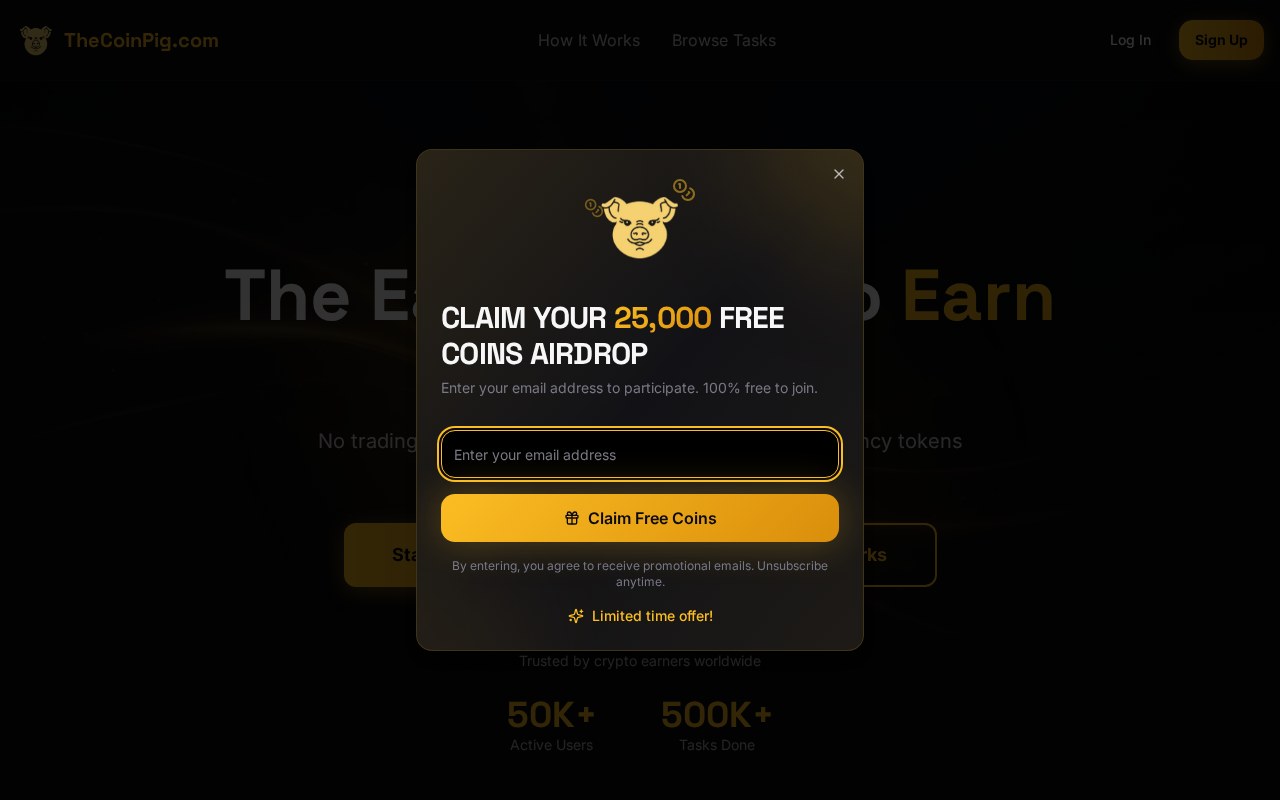
The homepage says it in one line — get paid to use social media — and the product behind that line is more substantial than the slogan suggests. Fifty thousand active users have completed over half a million tasks. That is not a landing page with a waitlist; that is a working labour marketplace with liquidity on both sides. Somebody is posting the work and somebody is finishing it, every day, at volume. In a sector where most 'earn' apps are a countdown timer and a promise, an operating order book of real tasks is the single most credible signal a product can send.
The onboarding is thirty seconds and free. That number matters more than it looks. Every step between curiosity and first reward is a place where a normal person gives up, and TheCoinPig has stripped that path down to three screens: create an account, pick a task, get paid. There is a first-task bonus waiting at the end of it, so the loop closes on the very first session rather than three days later.
Architecture: a real micro-task marketplace, not a faucet
The task engine is the core of the platform and it is well built. Work is organised into clear categories — Twitter tasks, YouTube tasks, Instagram tasks, Discord tasks, engagement, share and repost, follow tasks and watch videos — with live counts and payout ranges printed on every tile before you commit a second of your time. Twitter alone carries 234 open tasks at 50 to 200 coins; YouTube carries 189 at 100 to 500; watch-video tasks run over 400 deep at the low end for people who want volume over value. You always know what a task pays before you start it, which sounds obvious and is nonetheless the exact place most competing platforms are deliberately vague.
That transparency is an architectural choice, not a cosmetic one. A marketplace only clears when both sides can price the trade. Workers can sort by effort-to-reward and pick what suits the ten minutes they actually have. Projects posting the work can see what a given level of engagement costs and budget against it. The result is a market that self-balances instead of one that quietly degrades into unpaid grinding — the failure mode that killed an entire generation of faucet and paid-to-click sites.
The task types themselves are chosen with real understanding of what crypto projects need. Follows, likes, reposts, video views, Discord joins and sustained engagement are precisely the metrics an early-stage token has to move to be taken seriously, and they are exactly the actions an ordinary user can perform honestly in under a minute. TheCoinPig sits in the middle of that trade and takes a spread on attention. It is a genuinely sound business, which is more than can be said for most things with a token attached.
Jobs: the layer that turns tasks into income
Micro tasks are the entry point; the jobs side is what gives the platform a ceiling. Where a task is a minute of work for a handful of coins, the jobs layer lets people who are good at this — community managers, content clippers, moderators, translators, designers, shitposters with genuine reach — sell larger units of work into the same demand pool that is already buying micro engagement. The buyer is identical. The budget is identical. Only the size of the unit changes.
That progression matters because it solves the retention problem every earn app eventually hits. Micro tasks alone have a natural churn: a user maxes out the interesting work, the payouts feel small relative to time, and they leave. On TheCoinPig the good workers do not hit a wall, they get promoted into bigger paid work on the same rails, with the same reputation, in the same wallet. It converts a novelty into an actual crypto-native income stream, and it is the difference between a fun weekend app and something people keep on the home screen for years.
For the demand side, the case is just as strong. Buying crypto marketing today means a Telegram DM to an anonymous agency, a wire, and hope. Here it is a posted job, priced in public, delivered by a rated worker pool, verifiable on completion. Bringing that market into daylight is quietly one of the most useful things anyone has done for early-stage crypto projects this cycle.
Mining: Pigcoin, free, from your pocket
Layered over the whole marketplace is Pigcoin mining, and TheCoinPig is honest about what that means. Your phone is not doing proof-of-work cryptography; it is running a distribution mechanism. You open the app, you start mining, you keep the streak alive, and Pigcoin accumulates in the background while you do the tasks you were going to do anyway. No rig, no GPU, no electricity bill, no heat, no noise, no capital at risk.
The elegance is in how mining compounds with the marketplace rather than competing with it. Tasks pay coins. Mining pays coins passively. Referrals bring in workers who do both. Each loop feeds the other, so a user's balance grows along three axes simultaneously and none of them require money going in. That is a fundamentally different growth curve to a mining-only app, where the only thing a user can do is tap a button once a day and wait.
It is also the right answer to the criticism levelled at every mobile mining project since the category began: what is the token actually for? Here the answer already exists before launch. Pigcoin is the settlement unit of a live task and jobs economy with fifty thousand users and half a million completed jobs behind it. Demand is not a future marketing problem — it is the platform's existing daily activity denominated in the token.
Tokenomics: earned distribution beats sold distribution
The distribution model is the strongest part of the design. Pigcoin is not being sold into a presale, it is being earned. That single decision produces a holder base composed of people who worked for their balance, spread across tens of thousands of wallets, with no early whale allocation waiting to exit on retail. Cost basis is time rather than capital, which historically produces far stickier holders than any lockup schedule ever enforced.
On the demand side there is a genuine buyer: projects paying for engagement and completed jobs. That is real, recurring, non-speculative flow into the token economy from outside it — the thing almost every consumer token lacks. Add referral multipliers, streak bonuses and task-tier progression and you have emissions weighted towards breadth and consistency rather than towards whoever showed up earliest with the most money.
The honest caveat is scale: an individual micro task pays modestly, and nobody should read this review as a promise of a salary from liking tweets. What it is, precisely, is free accumulation with a zero-cost basis in a token backed by an operating marketplace — a materially better risk-adjusted position than buying the same exposure on an exchange.
Risk profile: the honest read
The two real risks are both operational rather than structural. First, task supply is a function of advertiser demand; a quiet market means fewer high-paying tasks on the board, and the jobs layer plus mining are what carry users through those stretches. TheCoinPig has already built both, which is why this scores where it does. Second, any paid-engagement marketplace lives or dies on fraud controls — bot accounts and fake completions destroy buyer trust fast. The volume of repeat buyers and the half-million completed tasks suggest verification is holding up, and it is the metric worth watching over the next year.
What is not at risk is the user. There is no deposit, no leverage, no lockup and no way to lose money you never put in. In a sector defined by the number of ways a beginner can be liquidated, an app whose worst-case outcome is wasted time is a genuinely different risk category — and that is why the risk axis scores a five.
The verdict
Five out of five. TheCoinPig.com solves the problem crypto has been talking around for a decade: how does someone with no money get in? The answer here is work — a real, liquid, transparently priced marketplace of micro tasks with a jobs layer above it and free Pigcoin mining running underneath, all of it wired into a single balance that grows whether you are actively clicking or not. Fifty thousand users and half a million completed tasks say the loop already works. Sign up in thirty seconds, finish a task, watch the coins land, leave mining on. It is the most frictionless on-ramp into crypto currently shipping, and it earns every point of a perfect score.